DIY Bookkeeping vs. Outsourcing for Australian Companies
Running a business in Australia means navigating GST obligations, BAS lodgements, Single Touch Payroll, and the ATO’s record-keeping requirements — all while actually running the business. At some point, every owner faces the same question: handle the books yourself, or hand them off?
The honest answer depends on your transaction volume, growth stage, and how much your time is actually worth.
Short answer: DIY bookkeeping suits sole traders and micro-businesses with low transaction volumes and simple GST obligations. Once payroll enters the picture, revenue streams multiply, or compliance complexity grows, outsourcing typically delivers better outcomes per dollar spent.
Key Takeaways
- DIY bookkeeping costs less upfront but carries real risks around compliance errors, ATO penalties, and opportunity cost.
- Outsourced bookkeeping with a registered BAS Agent provides professional accountability and legally covers BAS preparation and lodgement.
- Most Australian businesses start DIY and transition to outsourcing — the trigger is usually hiring the first employee or hitting $75,000 GST turnover.
- Cloud software (Xero, MYOB, QuickBooks Online) has made DIY more accessible, but software alone doesn’t replace bookkeeping knowledge.
- The hidden cost of DIY isn’t the software subscription — it’s the hours you spend doing something a professional does faster and with fewer mistakes.
What Bookkeeping Actually Involves for Australian Businesses
Bookkeeping is the systematic recording of every financial transaction — income, expenses, payroll, and tax obligations — in a way that produces accurate financial records. It’s not accounting (that’s the interpretation and analysis layer), but it feeds everything accounting depends on.
For Australian businesses, bookkeeping requirements set by the ATO aren’t optional. You must keep records for five years, reconcile GST on a monthly or quarterly cycle via your Business Activity Statement, and report payroll through Single Touch Payroll if you have employees. Miss a BAS lodgement? Penalties apply. Misclassify GST? You’re liable for the shortfall, plus interest.
This is where the stakes differ from, say, tracking personal expenses in a spreadsheet. A single coding error in your GST can ripple through your BAS, your income tax return, and your cash flow forecast simultaneously.
DIY Bookkeeping: Where It Works and Where It Falls Apart
The appeal is straightforward — lower costs, more direct visibility into your numbers, and no dependency on a third party. For a sole trader with 30–50 transactions a month, Australian bookkeeping software like Xero or MYOB makes this genuinely manageable.
Where DIY holds up well:
- Simple revenue streams (one product, one service, one bank account)
- No employees or contractors requiring payroll
- GST-exempt or straightforward GST coding
- Owner has some financial literacy and consistent time to maintain records
Where it starts to crack:
Most people underestimate the time investment. Bookkeeping done properly — not just entering invoices but reconciling accounts, checking GST codes, managing accounts payable and receivable, and preparing for BAS — takes 4–8 hours per month for even a modest operation. That figure climbs fast with transaction volume.
There’s also the common bookkeeping mistakes problem. Misclassifying expenses, missing bank reconciliation discrepancies, or incorrectly applying GST credits are errors that don’t announce themselves. They quietly accumulate until your accountant finds them at tax time — and by then, fixing them costs more than outsourcing would have.
What Outsourced Bookkeeping Actually Delivers
Outsourcing means engaging a professional bookkeeper — often a registered BAS Agent or an ICB-accredited firm — to manage your financial records on your behalf. The scope can range from data entry and reconciliation to full month-end reporting and BAS lodgement.
The compliance benefit is significant. A registered BAS Agent can legally prepare and lodge your BAS under the Tax Agent Services Act 2009, carry professional indemnity insurance, and stay current with ATO changes. That’s not something Xero does for you automatically.
Beyond compliance, outsourcing bookkeeping services tends to pay for itself in two ways: time recovered (you stop spending Sunday afternoons on expense tracking) and error reduction (professionals catch problems before they compound). As your business scales, you also gain access to cleaner financial reporting — which matters when you’re applying for an Australian business loan, pitching investors, or planning headcount.
The contrarian point most articles miss: outsourcing isn’t just for large businesses. A freelancer billing $120,000 annually with irregular project income, mixed GST, and quarterly BAS obligations often saves money by outsourcing — not because the volume is high, but because the complexity per transaction is.
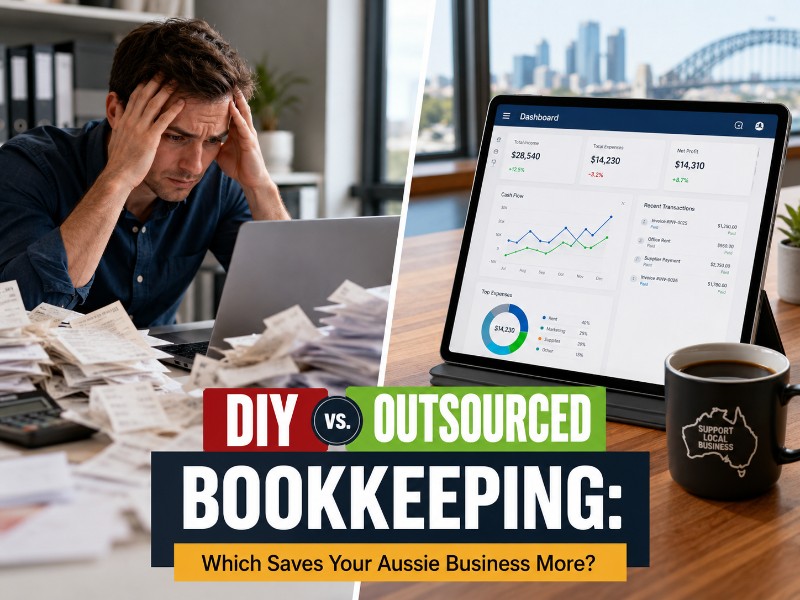
Side-by-Side: DIY vs. Outsourced Bookkeeping
| Factor | DIY Bookkeeping | Outsourced Bookkeeping |
|---|---|---|
| Upfront cost | Low (software subscription) | Higher (service fees) |
| Time required | 4–10+ hours/month | Minimal (review only) |
| BAS preparation | Owner-managed | Registered BAS Agent handles legally |
| Error risk | Higher without bookkeeping training | Lower with professional oversight |
| Payroll compliance | Risk-prone under STP requirements | Professionally managed |
| Scalability | Limits as transactions grow | Scales with business |
| Financial visibility | Direct but time-intensive | Structured reporting on schedule |
| ATO audit support | Owner-dependent | Professional representation available |
One thing that table doesn’t capture: the psychological cost. Business owners who manage their own books often describe a low-grade anxiety around compliance deadlines — BAS due dates, STP obligations, EOFY reconciliations. That cognitive load has a real cost, even if it doesn’t show up on a balance sheet.
The Real Costs of Each Option
DIY bookkeeping is rarely as cheap as it looks. Xero’s small business plans run approximately AUD $35–$85 per month depending on features. MYOB sits in a similar range. Add the time cost — if your effective hourly rate is $80 and bookkeeping takes 6 hours monthly, that’s $480 worth of your time, plus the software subscription.
Outsourced bookkeeping fees vary considerably. A basic sole trader package from a virtual bookkeeper might run AUD $200–$400 per month. A growing SME with payroll, multiple accounts, and monthly reporting might pay $600–$1,200. BAS preparation alone, handled by a registered BAS Agent, typically costs $150–$400 per lodgement depending on complexity.
Fixed-price bookkeeping packages in Australia have made it easier to budget for outsourcing — many providers now offer tiered monthly plans rather than hourly billing, which removes the anxiety of unpredictable invoices.
The hidden cost of DIY that never appears in the comparison: penalty interest on ATO shortfalls from miscalculated GST or late BAS lodgements. A single BAS error can easily exceed a year’s worth of outsourcing fees.
Who Should Stay DIY (For Now)
Certain business profiles genuinely suit DIY bookkeeping, and there’s no reason to outsource prematurely.
Bookkeeping essentials for sole traders are manageable with modern software if your operation is simple: one ABN, one income stream, no employees, and GST either exempt or straightforward. A freelance graphic designer, independent consultant, or home-based retailer with clean transaction records and consistent habits can maintain compliance competently with Xero and 2–3 hours of attention per month.
The practical test: if you can reconcile your bank account, code every transaction correctly, and lodge BAS without dread — and do it consistently — you don’t need to outsource yet.
The Real Signals That It’s Time to Outsource
Growth is the most reliable trigger, but not the only one. Watch for these:
Hire your first employee. Single Touch Payroll, superannuation guarantee obligations, and Fair Work compliance make payroll one of the highest-risk areas for DIY errors. The payroll bookkeeping compliance requirements in Australia shift significantly the moment you move from contractor payments to employment.
GST turnover crosses $75,000. Mandatory GST registration brings quarterly or monthly BAS obligations. If you’re not confident in GST coding across multiple expense types, that’s when professional oversight earns its fee.
You’re behind on reconciliations. If your accounts are more than two weeks out of date regularly, the problem isn’t motivation — it’s capacity. Outsource before it becomes a catch-up job costing double.
You’re making decisions without reliable numbers. Cash flow forecasting, pricing decisions, and growth planning all require accurate books. If you’re unsure whether your P&L reflects reality, that uncertainty costs you.
Construction companies, hospitality businesses during peak trading periods, and eCommerce retailers with high transaction volumes are particularly prone to DIY bookkeeping breaking down under load.
How to Choose: A Practical Framework
Rather than a checklist, work through these four questions:
What’s your transaction volume? Under 50 transactions per month with clean categorisation: DIY is viable. Over 100 transactions monthly, especially with mixed GST: outsourcing typically wins on time and accuracy.
Do you have payroll obligations? If yes, strongly consider outsourcing. Single Touch Payroll compliance is complex and penalties for errors are real.
What’s your actual hourly rate? Calculate what you earn per hour in your core business activity. If bookkeeping takes 8 hours a month and a bookkeeper charges $300, the maths usually favours outsourcing for anyone billing more than $40 per hour.
Are you growing? A hybrid model — handle day-to-day data entry, outsource BAS preparation and reporting — works well for businesses in transition. Many firms start with virtual bookkeeping arrangements precisely because it’s flexible without requiring a full-time hire.
The goal isn’t to find the cheapest option. It’s to find the option that keeps your records accurate, your compliance current, and your time directed toward revenue-generating activity.
Frequently Asked Questions
Is DIY bookkeeping suitable for every Australian business?
No. It works well for sole traders and micro-businesses with simple finances and low transaction volumes. As payroll, GST complexity, and revenue streams grow, the error risk and time cost of DIY typically outweigh the savings. Most businesses find a natural transition point between 12 and 36 months of operation.
How much does outsourced bookkeeping cost in Australia?
Fees vary based on business size, transaction volume, and scope of services. Sole trader packages typically start around AUD $200–$400 per month. Businesses with payroll and monthly reporting often pay $600–$1,200 monthly. BAS preparation by a registered BAS Agent usually costs $150–$400 per lodgement.
Can you switch from DIY to outsourced bookkeeping later?
Yes — and many Australian businesses do exactly that. The transition is smoother if your records are current and organised. If you’ve fallen behind, expect a catch-up fee from the incoming bookkeeper to bring accounts to date before ongoing work begins.
Do outsourced bookkeepers help with BAS?
A registered BAS Agent can legally prepare and lodge your Business Activity Statement under the Tax Agent Services Act 2009. They’re also responsible for ensuring the BAS reflects accurate GST, PAYG withholding, and any other obligations — and they carry professional indemnity insurance covering their work.
Which bookkeeping software is most popular in Australia?
Xero dominates the Australian small business market and integrates well with most accountants and BAS Agents. MYOB suits businesses that prefer locally-developed software with strong Australian payroll compliance. QuickBooks Online is a strong option for businesses already using it internationally or wanting its reporting depth. The best platform is whichever one your bookkeeper or accountant uses — seamless collaboration matters more than feature preferences