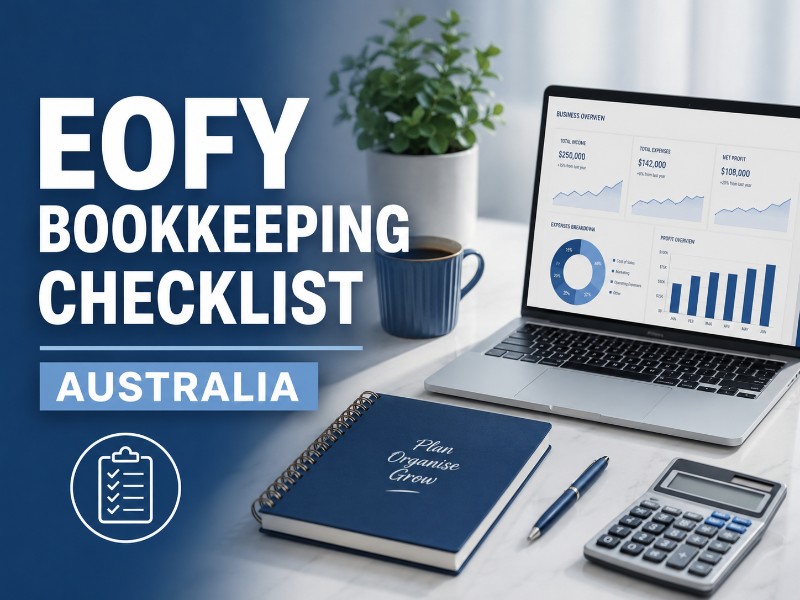
End of Financial Year Bookkeeping Australia Checklist
The end of financial year catches a lot of Australian businesses off guard. Not because they didn’t know it was coming — 30 June has been on the calendar forever — but because the gap between “roughly keeping records” and “actually being EOFY-ready” is wider than most people expect until they’re standing right in the middle of it.
Good EOFY bookkeeping isn’t just about ticking boxes for the ATO. Done properly, it gives you a clear picture of where the business actually stands, flags cash flow problems before they become critical, and takes a significant amount of stress out of tax time. Whether you’re running as a sole trader, partnership, or company, the fundamentals are largely the same — the scale differs, but the process doesn’t.
This checklist walks through every major area you need to cover before 30 June, including the parts that tend to get overlooked.
1. Understand EOFY Bookkeeping Requirements in Australia
Australia’s financial year runs from 1 July to 30 June. That’s the window the ATO uses when it assesses income, deductions, GST, and payroll obligations — so everything your bookkeeping captures needs to align with those dates.
Here’s something worth clarifying early: bookkeeping and tax preparation aren’t the same thing. Bookkeeping is the ongoing process of recording, categorising, and reconciling financial transactions throughout the year. Tax preparation sits on top of that — it uses the records your bookkeeping produces. If the bookkeeping’s a mess, the tax work becomes expensive and slow.
Common compliance obligations most Australian businesses face include:
- Lodging Business Activity Statements (BAS) — monthly or quarterly, depending on your GST registration
- Meeting Single Touch Payroll (STP) reporting requirements if you have employees
- Paying the correct Goods and Services Tax (GST) and PAYG withholding to the ATO
- Maintaining records linked to your Australian Business Number (ABN)
None of these are difficult in isolation. The issue is usually that they’ve been pushed aside during the year, and by June there’s a backlog to sort through.
2. Reconcile Every Business Account
Bank reconciliation is the starting point. You’re matching every transaction in your accounting software against your actual bank statements — line by line — so that the closing balances agree.
This matters more than it sounds. Unreconciled accounts hide duplicated entries, missed payments, and bank fees that quietly eat into your figures. Most business owners reconcile their main operating account reasonably well, but the others get neglected.
Here’s a practical comparison of the accounts that typically need reconciling and the issues each tends to produce:
| Account Type | Common Issues Found |
|---|---|
| Business bank account (NAB, CommBank, etc.) | Duplicate transactions, missed direct debits |
| Business credit card | Personal expenses mixed with business, unmatched receipts |
| Business loans | Incorrect interest allocations, missing repayments |
| Payment gateways (Stripe, PayPal) | Fee deductions not captured, timing differences |
| Petty cash | Missing receipts, unrecorded small purchases |
In practice, payment gateways tend to be the messiest — mainly because Stripe and PayPal net off their fees before depositing, which means the figure hitting your bank account doesn’t match the gross sales figure. It needs a specific adjustment. Most people find this out the hard way.
3. Review Income and Business Expenses
Before you close the year, go through every invoice issued and make sure it’s recorded. Outstanding invoices that relate to work done before 30 June count as income for this financial year — even if they haven’t been paid yet (assuming you’re on an accruals basis).
On the expense side, go through your accounts payable. Supplier bills received before 30 June are generally deductible in this year. Don’t leave them in a pile on the desk.
Some specific expense areas worth reviewing:
- Capital purchases: Items over the relevant threshold may qualify under the Instant Asset Write-Off scheme. The rules around this change regularly, so confirm with your accountant what’s applicable for the current year.
- Depreciation: Assets purchased in prior years continue to depreciate. Make sure your depreciation schedule is up to date.
- Business deductions: Home office costs, vehicle expenses, subscriptions, and professional development can all be deductible. The key is having supporting records for each.
A quick scan through bank statements for any business costs not yet recorded often turns up a handful of deductions that would otherwise be missed.
4. Check Payroll, Superannuation and Employee Records
Payroll compliance is one area where getting it wrong carries real consequences — both financially and legally. The Fair Work Ombudsman takes underpayments seriously, and the ATO monitors superannuation closely.
Run through the following before year-end:
STP reporting: Every pay event throughout the year should have been reported through Single Touch Payroll. Log into your payroll software and confirm there are no gaps or failed submissions.
Superannuation: The Superannuation Guarantee rate for 2024-25 is 11.5%. Super for the April-June quarter must be paid and received by the fund by 28 July — but to claim the deduction in this financial year, it needs to be paid before 30 June. This is a timing issue that catches businesses out every year.
PAYG withholding: Make sure the total withheld from employee wages matches what’s been reported to the ATO through BAS lodgements.
Leave balances: Annual leave and long service leave accruals need to be reflected correctly on the balance sheet. If there are discrepancies between what employees expect and what’s recorded, sort that out now.
A payroll reconciliation — comparing your payroll system totals against your accounting software — will usually expose any mismatches.
5. Review GST, BAS and Tax Obligations
GST errors are probably the most common bookkeeping issue found at EOFY. Transactions miscoded as GST-free when they should have GST included (or vice versa) distort your BAS and can trigger ATO adjustments later.
Walk through the following:
GST coding: Review a sample of transactions in each major expense category. Look for anything coded incorrectly — particularly purchases from overseas suppliers (which are typically GST-free) and insurance (which is usually GST-applicable but often miscoded).
BAS review: Reconcile the GST figures in your accounting software against every BAS lodged during the year. The totals should match.
Record retention: The ATO requires records to be kept for five years. That includes tax invoices, bank statements, payroll records, and BAS lodgements. Make sure everything is stored somewhere accessible.
If you’re using ATO Online Services for Business, you can check the status of lodgements and confirm there are no outstanding obligations sitting unresolved.
6. Organise Financial Reports for EOFY
Your accountant will need a core set of reports to prepare your tax return. Generating these through your accounting software is straightforward — but they’re only useful if the underlying data is accurate. Which is why all the reconciliation work comes first.
The key reports are:
- Profit and Loss Statement: Shows revenue, expenses, and net profit or loss for the year.
- Balance Sheet: A snapshot of assets, liabilities, and equity at 30 June.
- Cash Flow Statement: Tracks actual cash movements — useful for understanding why profitable businesses still run short of cash.
- Trial Balance: A summary of all ledger account balances, used to confirm the books are balanced.
- General Ledger: The full transaction-level detail behind each account.
Run these reports and review them before sending anything to your accountant. If the net profit figure looks dramatically different from what you’d expect, that’s worth investigating before the accountant does.
7. Review Business Assets and Inventory
If the business holds physical assets — vehicles, equipment, computers, machinery — there should be an asset register that tracks what was purchased, when, and for how much. Update it to reflect anything bought or disposed of during the year.
For businesses holding inventory, a stocktake needs to happen before or very close to 30 June. The value of closing stock affects your taxable income directly, so getting this right matters.
A few things to check:
- Write-offs: Any stock that’s damaged, obsolete, or unsellable can generally be written off. Document the reason and the value.
- Depreciation: Confirm the depreciation on all fixed assets has been calculated correctly for the year.
- Equipment purchases: Cross-check any new equipment against your asset register to make sure nothing’s been expensed incorrectly.
8. Back Up Records and Prepare for Your Accountant
Once everything’s reconciled and reviewed, the last step is making sure the records are secure and organised.
Cloud-based bookkeeping software — Xero, MYOB, QuickBooks Online — stores data automatically, but it’s still worth exporting key reports and saving them separately to Google Drive or Microsoft OneDrive. Software subscriptions change, and having locally-saved copies removes a potential point of failure.
When preparing your handover for the accountant, include:
- Final reconciled reports (P&L, Balance Sheet, Trial Balance)
- Bank statements for the full year
- Copies of BAS lodgements
- Payroll summaries and STP finalisation
- Any supporting documents for major transactions
The more organised the handover, the lower the accounting fee. Accountants typically charge by time — and time spent hunting for missing documents adds up quickly.
9. Common EOFY Bookkeeping Mistakes to Avoid
A few patterns show up repeatedly at year-end:
Missing receipts: The ATO requires substantiation for expense claims. A transaction in the bank feed without a matching receipt is a risk. Most accounting software allows you to attach receipts directly to transactions — use that feature throughout the year, not just at EOFY.
Incorrect GST coding: Flagged earlier, but worth repeating. A single miscoded category applied consistently for 12 months creates a meaningful GST error by June.
Unreconciled accounts: Don’t finalise the year with unreconciled bank accounts or credit cards. Unmatched transactions are usually errors — and errors compound.
Late super payments: Super paid after 30 June isn’t deductible in this financial year. This is a consistent issue, particularly for businesses that run tight on cash at year-end.
Duplicate transactions: Bank feeds occasionally import the same transaction twice. A thorough reconciliation catches this, but a rushed one often doesn’t.
10. EOFY Bookkeeping Checklist (Printable Summary)
Here’s the quick-reference version you can print and work through:
- Reconcile all bank accounts, credit cards, and payment gateways
- Match all invoices issued to income recorded
- Review and record all supplier bills
- Confirm payroll figures match STP reports
- Pay superannuation before 30 June to claim this year’s deduction
- Review all GST coding and reconcile against BAS lodgements
- Verify deductible business expenses have supporting receipts
- Generate and review Profit and Loss, Balance Sheet, and Trial Balance
- Complete stocktake and update asset register
- Back up all bookkeeping files to cloud storage
- Prepare and send documentation to your accountant
Final Thoughts
EOFY bookkeeping isn’t glamorous work. But done thoroughly, it removes a significant amount of uncertainty from the tax process, gives the business owner a clear view of financial performance, and reduces the risk of ATO compliance issues later.
The businesses that find EOFY painless are almost always the ones that maintain clean records throughout the year, not just in June. Starting with even basic monthly reconciliations transforms the year-end process from a stressful scramble into a straightforward review.
If the current year has been messy, that’s fine — work through the checklist above, get the records organised, and use this EOFY as the reset point for cleaner bookkeeping going forward